

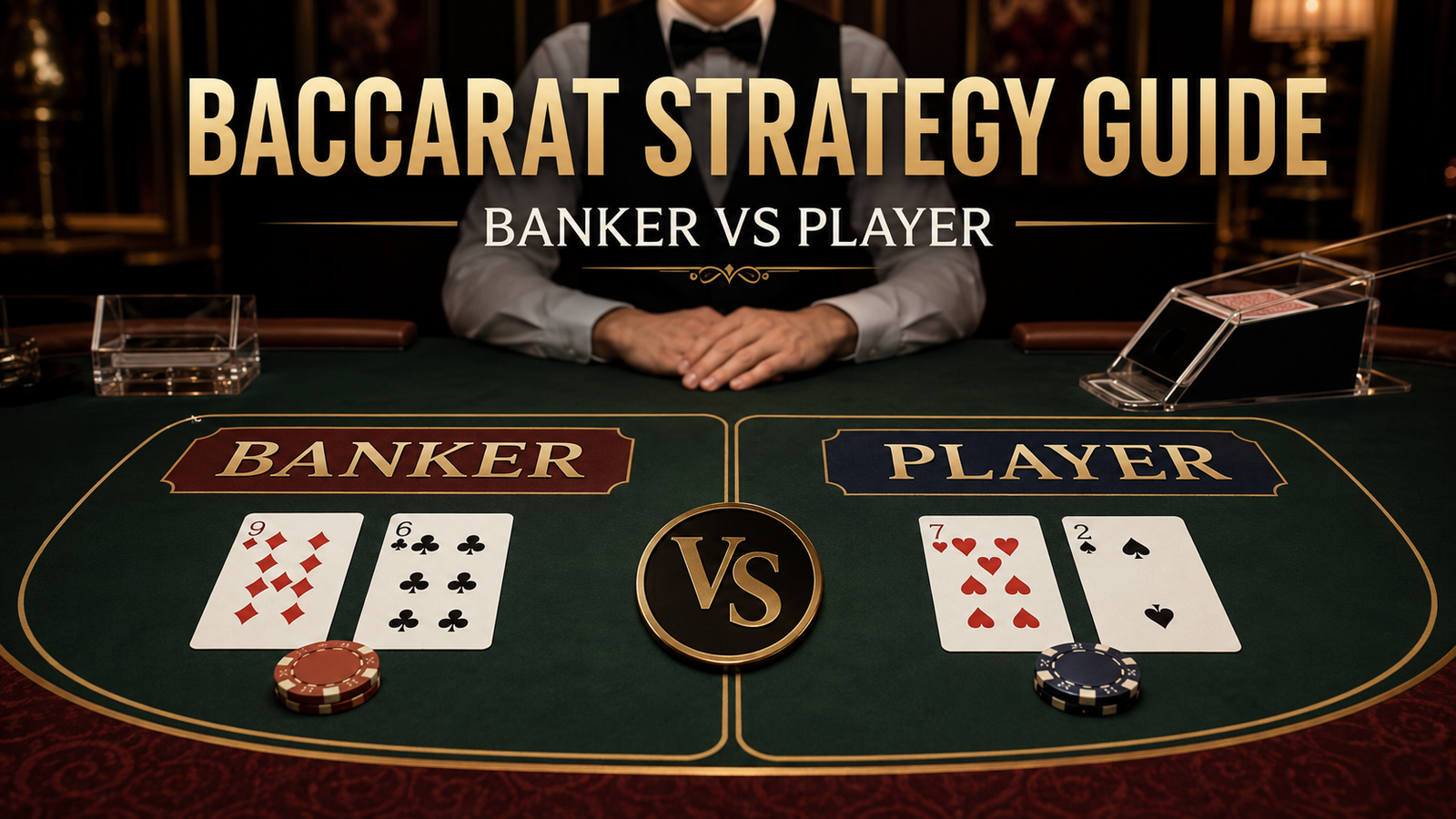
Three bets on the table at SpinAUD, one clear mathematical winner, and most beginners still bet on the wrong one out of habit. Baccarat looks intimidating with its formal-sounding “Banker” and “Player” labels, but strip away the ceremony and it’s really just a coin flip with a small commission attached to the better side. Any real baccarat strategy starts with understanding that commission, because it’s the whole reason one bet quietly beats the other over time.
Here’s how the numbers actually break down between banker vs player baccarat, why the tie bet is a trap dressed up as a big payout, and what a sensible baccarat strategy looks like once you’ve seen the math.
Why Baccarat Strategy Comes Down to Three Bets
Every hand in baccarat gives you exactly three choices: bet on Banker, bet on Player, or bet on a Tie. Two cards are dealt to each side, a third card gets drawn under fixed rules depending on the totals, and whichever hand is closer to 9 wins. There’s no skill involved in how the cards play out — the only decision you actually make is which bet to place before the cards are dealt, and that’s the entire foundation of any baccarat strategy worth following.
That single decision is where baccarat strategy lives entirely. Get the bet right and you’re playing one of the lowest house-edge games in the casino. Get it wrong repeatedly and you’re giving away value on every single hand — which is really the whole case for having a baccarat strategy at all instead of picking a side at random.
The Banker Bet Explained
The Banker bet wins slightly more often than the Player bet, purely because of how the drawing rules are structured. To balance that edge, casinos charge a 5% commission on Banker wins. Even after that commission, Banker still comes out ahead mathematically, carrying a house edge of roughly 1.06%, the lowest of the three options by a clear margin.
This is why serious baccarat strategy almost always points toward Banker as the default bet. The commission feels annoying in the moment, especially the first time you see it deducted from a win, but the underlying math still favours this side of the table. Anyone weighing up banker vs player baccarat for the first time usually lands here once the numbers are actually laid out.
The Player Bet Explained
The Player bet carries no commission at all, which makes it feel like the more generous option. It isn’t, quite. Player loses slightly more often than Banker over a large enough sample, landing at a house edge of about 1.24%. That’s still very good as far as casino games go, just not quite as strong as Banker once the commission is factored in.
Plenty of players choose Player anyway simply because they don’t like paying a fee on a win, and that’s a reasonable enough preference given how small the gap actually is. A baccarat strategy built entirely around avoiding commission isn’t unreasonable, it’s just very slightly less optimal than one built around raw house edge.
Banker vs Player Baccarat: The Numbers Side by Side
Laying out banker vs player baccarat side by side makes the decision a lot less complicated than it feels at the table:
| Bet | House Edge | Commission | Win Probability |
| Banker | 1.06% | 5% on wins | ~45.9% |
| Player | 1.24% | None | ~44.6% |
| Tie | 14.36% | None (pays 8:1 or 9:1) | ~9.5% |
The gap between Banker and Player is small enough that either is a reasonable choice for casual play. The Tie bet is a different story entirely — it pays a tempting 8:1 or 9:1, but the house edge is more than ten times worse than either main bet.

Why the Tie Bet Doesn’t Belong in a Real Strategy
A 9:1 payout looks exciting on paper, and that’s exactly the point — it’s designed to look exciting. A tie only happens roughly one hand in ten, and the payout doesn’t come close to compensating for how rarely it lands. No serious baccarat strategy includes betting Tie as a regular play, whether you’re leaning Banker or Player on the main bet. It’s a novelty bet at best, and a bankroll-drainer if you lean on it.
How the Third Card Actually Gets Decided
The reason Banker edges out Player at all comes down to a fixed set of drawing rules most players never bother learning, since the dealer handles them automatically. Player draws a third card on totals of 0 through 5, and stands on 6 or 7. Banker’s rule is more layered: it reacts to what Player just did, drawing or standing based on a table of conditions built specifically so that Banker sees slightly better outcomes on average across a full shoe.
None of this changes what you actually need to do at the table — the drawing happens automatically either way. But it explains why any banker vs player baccarat comparison always lands slightly in Banker’s favour before the commission even gets applied, and why that edge survives even after the 5% fee comes off.
Baccarat Strategy for a Full Shoe, Not Just One Hand
A single hand of baccarat is close to a coin flip no matter which side you pick. Where baccarat strategy actually starts to matter is across a full session — dozens of hands, not just one. Small edges compound. A 1.06% house edge on Banker versus a 1.24% edge on Player barely registers over ten hands, but stretch that out to a hundred and the gap becomes real money.
This is also where a lot of players get tripped up by short-term results. Watching Player win five hands in a row doesn’t mean Player is the better bet that session — it just means variance did what variance does. Sound baccarat strategy ignores that noise and sticks with the underlying math regardless of the last few outcomes on the scoreboard.
Baccarat Tips Beyond Just Picking a Side
A handful of baccarat tips matter more than agonising over Banker versus Player every single hand:
- Skip the Tie bet entirely unless you’re wagering a token amount purely for fun — this is one of the simplest baccarat tips going, and also the most ignored
- Stick with Banker as your default if minimising house edge is the priority, and accept the commission as the cost of that edge
- Avoid side bets like Dragon Bonus or Pairs unless you understand the specific odds, since most of these carry a far worse house edge than the three main bets
- Set a per-session limit before you sit down, since baccarat moves fast and hands go by quickly compared to other table games
- Ignore pattern-reading systems that track previous results on a scoreboard — each hand is independent, and past outcomes don’t influence what comes next
These baccarat tips won’t turn a losing session into a winning one, but they keep you playing the version of the game with the best odds available. Following even two or three of these baccarat tips consistently does more for your results than switching between Banker and Player based on a hunch.
Where to Play Baccarat and What Else to Try
SpinAUD’s live casino runs real-dealer baccarat tables, and our dedicated guide to live baccarat at SpinAUD covers table limits, how the commission gets handled at the table in practice, and a closer look at banker vs player baccarat specific to those tables. If you’re building out a wider live-table strategy, our guides to roulette odds and live blackjack strategy cover similar ground for players moving between games, with their own set of practical tips alongside these baccarat tips. And when you want something outside the live tables entirely, SpinAUD’s online pokies library is sitting on the same account.

Frequently Asked Questions
1. Is Banker or Player the better bet in baccarat?
Banker, by a small but consistent margin. Its house edge sits at roughly 1.06% even after the 5% commission on wins, compared to about 1.24% for Player. The difference is small, but any serious baccarat strategy leans Banker for exactly that reason, and it’s the first thing most baccarat strategy guides point out.
2. Why does the Banker bet charge a commission?
Because the Banker hand has a built-in mathematical advantage in how the third-card drawing rules work. The commission exists to bring that advantage back down closer to even, though Banker still edges out Player after the fee is applied.
3. Should I ever bet on Tie in baccarat?
Generally no. The payout looks attractive at 8:1 or 9:1, but the house edge on Tie is over 14%, dramatically worse than either Banker or Player. It’s a bet built around excitement rather than actual value.
4. Does banker vs player baccarat come down to luck or skill?
Almost entirely luck once the bet is placed. There’s no decision-making during the hand itself — the drawing rules are fixed. The only real strategic choice in banker vs player baccarat is which of the three bets you place before the cards come out.
5. Can betting systems improve my baccarat strategy?
No. Systems like Martingale or pattern tracking change how your bankroll moves during a session, but they don’t change the underlying house edge on Banker, Player, or Tie. Every hand is independent of the last, regardless of what came before it, which is why so many baccarat tips lists tell you to ignore the scoreboard entirely.

Suzzane is a seasoned casino content writer at SpinAUD,specialising in online pokies, slot strategies, and bonus insights for Australian players. Suzzane has reviewed 80+ Australian online casino platforms, with a focus on real-money withdrawal testing, bonus term analysis, and payment method reliability. The platforms reviewed on this page are selected and tested to help Aussie players find smarter, safer, and more rewarding real-money gaming options — whether you’re spinning for fun or chasing a fast cashout.