

Roulette Odds Explained: European vs American Roulette
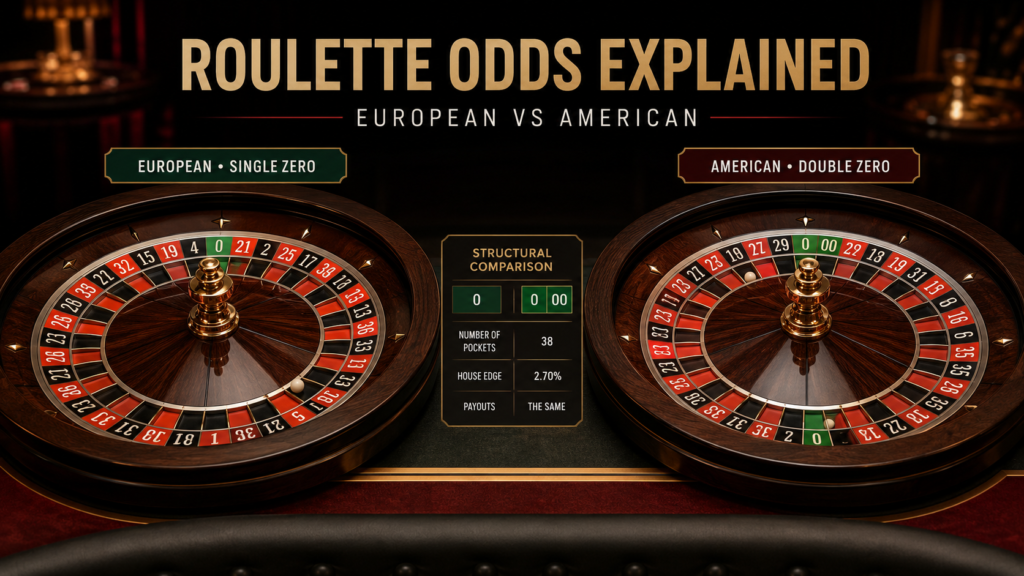
Two roulette wheels at SpinAUD, same colours, same numbers 1 through 36. Add one extra green pocket and the house edge nearly doubles. That’s the entire difference between European roulette and American roulette, and it’s worth knowing before you sit down at either table, because the roulette odds on offer aren’t remotely the same game underneath the paint job.
This one’s straightforward: how roulette odds actually work, what changes between a European wheel and an American one, and which bets are worth making once you know the numbers.
What Determines Roulette Odds in the First Place
Every bet on a roulette table pays out based on the actual probability of that number or group of numbers hitting. A straight-up bet on a single number pays 35 to 1, because on a wheel with 37 numbers, the true odds of hitting one specific number are 36 to 1. That tiny gap between the payout and the true odds is where the house edge lives, and it’s baked into every single bet on the table.
The one thing that changes the roulette odds more than anything else isn’t the bet type. It’s the wheel itself.
European Roulette: The Single-Zero Wheel
This single-zero wheel runs 37 pockets: the numbers 1 through 36 plus a single green zero. That single zero is what gives the house its edge. Work out the maths and it lands at 2.7%, meaning for every $100 wagered over a long run, the house keeps roughly $2.70 on average.
This is the wheel most serious players gravitate toward, and for good reason. European roulette gives you noticeably better roulette odds than its American cousin on every single bet type, without changing how the game is played or what the payouts look like on the felt.
American Roulette: The Double-Zero Wheel
American roulette adds a second green pocket, 00, bringing the total to 38 numbers. Same bets, same payouts, same table layout — but now there are two ways for the ball to land somewhere that doesn’t pay out on even-money bets or the single-number line. That extra pocket pushes the house edge up to 5.26%, essentially double what the single-zero wheel runs.
The maths adds up fast. Over a long session, American roulette will cost the average player roughly twice as much per dollar wagered compared to a European wheel, even though nothing about how you actually play changes.
Roulette Odds by Bet Type: European vs American
| Bet Type | True Odds | European Payout / House Edge | American Payout / House Edge |
| Straight up (1 number) | 36 to 1 (Euro) / 37 to 1 (US) | 35 to 1 / 2.70% | 35 to 1 / 5.26% |
| Split (2 numbers) | 17.5 to 1 (Euro) | 17 to 1 / 2.70% | 17 to 1 / 5.26% |
| Street (3 numbers) | 11.33 to 1 (Euro) | 11 to 1 / 2.70% | 11 to 1 / 5.26% |
| Corner (4 numbers) | 8.25 to 1 (Euro) | 8 to 1 / 2.70% | 8 to 1 / 5.26% |
| Dozen / Column | 2.08 to 1 (Euro) | 2 to 1 / 2.70% | 2 to 1 / 5.26% |
| Red/Black, Odd/Even | roughly even (Euro) | 1 to 1 / 2.70% | 1 to 1 / 5.26% |
Notice the pattern: the payout for each bet is identical between the two wheels. The house edge is what shifts, purely because of that extra pocket on the American layout, and it’s the whole story behind why the roulette odds diverge as much as they do.
Why the House Edge Difference Actually Matters
A 2.7% house edge doesn’t feel dramatic compared to 5.26% until you sit at the table for a few hours. Over 100 spins at $10 a spin, European roulette costs you roughly $27 on average in the long run. The same session on American roulette costs closer to $53. Nothing about your betting pattern changed — the wheel did all the work, and that’s the roulette odds difference in real dollars rather than percentages.
This is exactly why so many strategy guides push players toward the single-zero wheel whenever it’s available. The gameplay feels identical spin to spin, but the roulette odds working against you over a full session are close to half as harsh.
Bets Worth Making (and One to Avoid)
A handful of practical points once you understand the odds:
- Outside bets like red/black or odd/even carry the lowest variance, useful if you want your bankroll to last longer per session
- Inside bets like straight-up numbers pay far more but hit far less often, so size them knowing that
- On American tables specifically, avoid the five-number bet (0, 00, 1, 2, 3) if it’s offered — it carries a house edge of 7.89%, noticeably worse than every other bet on the table
- Stick to the single-zero wheel over the double-zero one whenever both are available, since the payout structure is identical but the underlying odds simply aren’t
- Set a session limit before you sit down rather than deciding mid-session, since the house edge compounds the longer you play regardless of which wheel you’re on
Where the Two Wheels Actually Came From
European roulette is the older of the two, tracing back to 18th century France, where the single-zero design was standardized well before the game ever crossed the Atlantic. American roulette picked up its second zero once the game took hold in the United States during the 1800s, and that extra pocket became the standard on nearly every wheel built in the country from that point on. The two versions have run in parallel ever since, and most online casinos today, SpinAUD included, offer both side by side so players can choose.
That history matters a little for context, but the practical roulette odds difference is really what should drive your choice at the table, not which version happens to be older. Knowing the roulette odds behind each wheel is more useful than knowing which one came first.
Reading a Table Before You Sit Down
Not every roulette table advertises which wheel it’s running in big letters, so a quick check before you commit real money is worth the ten seconds it takes:
- Count the green pockets. One means European roulette, two means American roulette
- Check the felt layout. American tables almost always show a “0” and “00” as separate pockets on the betting grid, right next to each other
- Look at the minimum and maximum bets listed, since European tables sometimes carry slightly different limits to American ones on the same platform
- If the platform lists a house edge or RTP figure directly, that number alone will confirm which wheel you’re looking at without needing to count pockets at all
Where to Play Either Version
SpinAUD’s live casino runs both European and American tables with real dealers, and our dedicated guide to live roulette at SpinAUD breaks down table limits and how to tell which wheel you’re sitting at before you place a single chip. If blackjack is more your speed, our live blackjack strategy guide covers a similar set of odds-based decisions for that table, and our breakdown of live baccarat is worth a look if you’re comparing house edges across the whole live floor. For anything outside live tables, SpinAUD’s online pokies library sits right alongside all of it on the same account.

Frequently Asked Questions
1. Which has better roulette odds, European or American?
European roulette, by a clear margin. Its single-zero wheel carries a 2.7% house edge compared to 5.26% on an American double-zero wheel, even though every bet pays out the same amount on both.
2. Why does one extra pocket make such a big difference?
Because that pocket is a loss for every even-money and single-number bet on the table, without changing the payout for a win. Adding just one more losing number to a 37-pocket wheel is enough to almost double the house’s edge.
3. Can I always choose European roulette over American?
Not always — it depends on what’s available at the platform or venue you’re playing at. When both are offered, though, there’s rarely a reason to pick American roulette over European unless you specifically prefer something about that table’s layout or limits.
4. Do outside bets have better roulette odds than inside bets?
Outside bets like red/black don’t have better roulette odds in terms of house edge — that’s identical across every standard bet on the same wheel. What outside bets offer is lower variance, meaning smaller, more frequent wins instead of rare big payouts.
5. Is there a strategy that beats the house edge in roulette?
No betting system changes the underlying roulette odds, since each spin is independent of the last. Progressive betting patterns can change how your bankroll swings in the short term, but none of them alter the 2.7% or 5.26% edge built into the wheel itself.

Suzzane is a seasoned casino content writer at SpinAUD,specialising in online pokies, slot strategies, and bonus insights for Australian players. Suzzane has reviewed 80+ Australian online casino platforms, with a focus on real-money withdrawal testing, bonus term analysis, and payment method reliability. The platforms reviewed on this page are selected and tested to help Aussie players find smarter, safer, and more rewarding real-money gaming options — whether you’re spinning for fun or chasing a fast cashout.