

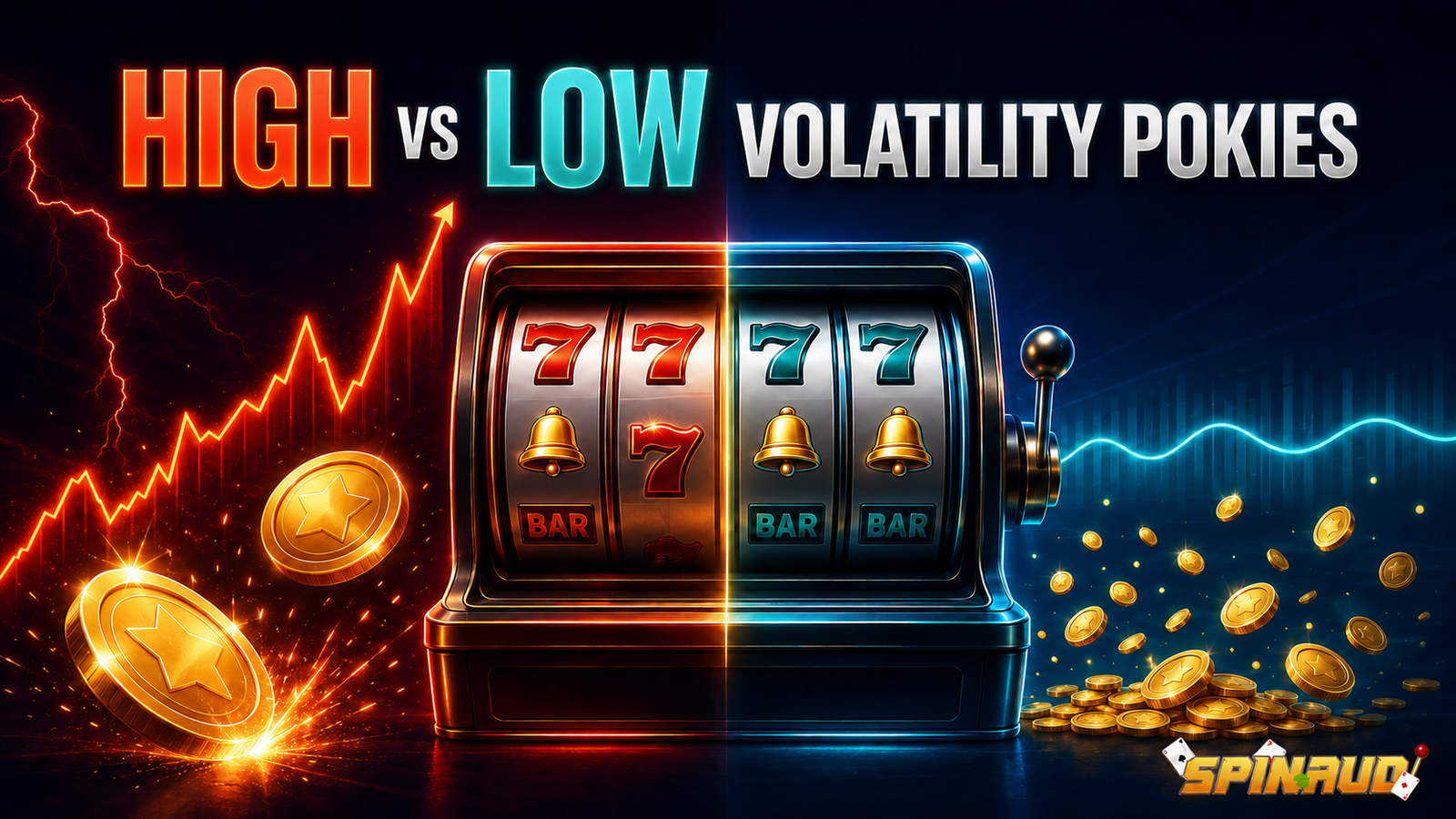
Pick any two pokies with the same theme and the same RTP, and they can still feel completely different to play. One pays small wins constantly. The other stays quiet for long stretches, then drops a payout big enough to make you sit up straight. That gap comes down to volatility, and it’s the single biggest factor in whether a game actually suits how you like to play at SpinAUD.
This guide breaks down high volatility pokies and low volatility pokies in plain terms, shows you how pokies volatility actually works under the hood, and helps you match your bankroll and patience level to the right games.
What Pokies Volatility Actually Means
Pokies volatility (sometimes called variance) describes the risk profile of a game — how often it pays out and how big those payouts tend to be. It has nothing to do with luck on a given day. It’s built into the math model of the slot itself.
A game with low pokies volatility is designed to return smaller wins on a regular basis. A game with high pokies volatility is built to hold onto your money longer between wins, then release a bigger chunk when it finally pays. Same RTP, completely different experience.
Understanding pokies volatility matters more than most players realise, because it directly affects how long your balance lasts per session and how big a bankroll you actually need to play comfortably.
High Volatility Pokies: What to Expect
High volatility pokies are built for players chasing size over frequency. Wins come less often, but when they land, they can be substantial — sometimes 50x, 100x, or more of your stake in a single spin.
What typically defines high volatility pokies:
- Long dry spells between winning spins, sometimes 20-30 spins with nothing
- Big payout potential when a win does land, often through bonus rounds or free spins
- Bonus features that are harder to trigger but pay far more when they do
- A bankroll that needs to be bigger relative to your stake size, to survive the dry spells
- A playing style suited to patience and a higher tolerance for losing streaks
Progressive jackpot pokies are a classic example of high volatility pokies pushed to the extreme — the jackpot pool grows because most spins contribute nothing back, until one spin pays out everything at once. If that style appeals to you, our guide breaks down how those pools build and what your realistic odds look like.
High volatility pokies suit players who don’t mind a quiet session as long as there’s a shot at a genuinely big result. If you’re the type who gets bored watching small wins trickle in, high volatility pokies are usually the better fit. Over a long enough run, high volatility pokies can reward that patience — but only if your bankroll is built to absorb the dry spells along the way.
Low Volatility Pokies: What to Expect
These games flip the formula. Instead of holding back for a rare big win, they pay smaller amounts more consistently, which keeps your balance moving and your session going longer on the same budget.
What typically defines this style:
- Frequent small wins, often every 3-5 spins
- Smaller maximum win potential compared to high volatility pokies
- Fewer big bonus features, or bonus rounds that pay modestly when triggered
- A smaller bankroll requirement per spin, since the swings are gentler
- A playing style suited to steady, relaxed sessions rather than chasing a jackpot
Classic pokies are usually where you’ll find this lower-variance style in its purest form — simple 3-reel games without heavy bonus mechanics, built for steady, predictable play rather than big swings. They’re a good starting point if you’re still working out what pace of play suits you.
Low volatility pokies are the better match if you’d rather stretch your session out and enjoy a longer play time, even if the ceiling on wins is lower.
High vs Low Volatility Pokies: Side-by-Side Comparison
| Factor | High Volatility Pokies | Low Volatility Pokies |
| Win frequency | Low — longer gaps between wins | High — frequent smaller wins |
| Win size | Large, sometimes 50x-100x+ stake | Small to moderate |
| Bankroll needed | Larger, to survive dry spells | Smaller, swings are gentler |
| Session length | Can be short if variance runs bad | Usually longer on the same budget |
| Best suited for | Players chasing a big result | Players who want steady, relaxed play |
| Example games | Progressive jackpots, feature-heavy slots | Classic 3-reel pokies, simple video slots |
This table is a starting point, not a rulebook. Plenty of games sit in the middle, offering moderate pokies volatility with a blend of both styles.
Which Playing Style Matches You?
Your bankroll, your patience, and what you actually want out of a session all point toward one side or the other:
- If you have a bigger bankroll and don’t mind long losing streaks for a shot at a big multiplier, high volatility pokies fit your style.
- If you’d rather play for longer with a smaller budget and enjoy regular small wins, the low volatility style fits you better.
- If you enjoy the tension of a near-miss and want every session to feel like a shot at something big, high volatility pokies keep that energy alive from spin to spin.
- If you’re new to pokies and still figuring out your preference, starting with lower pokies volatility games gives you more spins to learn the mechanics before stepping up.
- If you like tracking numbers like RTP alongside volatility, our breakdown of RTP pokies explains how that figure works alongside variance to shape your odds.
- If you want to understand exactly how often a game is designed to pay, our guide on hit frequency pokies covers the mechanics in more detail, since hit frequency and volatility are closely linked but not the same thing.
There’s no wrong answer here. Some players mix both styles depending on their mood or their budget for the session — running the gentler, lower-variance games as a warm-up, then switching to something with bigger swings once they’ve got a feel for the table.

Managing Your Bankroll Around Volatility
Whichever side you land on, your bankroll strategy should match it. For high volatility pokies, set aside a bigger buffer than you think you need, and accept that a session can end without a big win landing at all. For low volatility pokies, you can play with a tighter budget since the swings are smaller, but temper your expectations on the ceiling — you’re trading big win potential for a steadier ride.
A simple rule that works for most players: divide your session budget by your average bet, then check whether that number of spins feels comfortable given the volatility of the game you’ve picked. If it feels tight for a high-variance title, either lower your stake or shift toward something gentler for that session.
At SpinAUD, you can explore both ends of the spectrum through our full range of online pokies, filter by feature type, and get a feel for how different volatility levels play out before committing a bigger session budget to one style over another.
Frequently Asked Questions
1. What does volatility mean in pokies?
Volatility, sometimes called variance, describes how a pokie pays out over time. Low volatility games pay smaller wins more often, while high volatility games pay less frequently but with bigger payouts when they land. It’s a separate measure from RTP, which looks at long-term theoretical return rather than the size and frequency of individual wins.
2. Is high volatility or low volatility better for beginners?
Low volatility pokies are usually a gentler starting point. Frequent small wins keep your balance moving and give you more spins to understand how a game’s features work, without the bankroll pressure that comes with the long dry spells typical of high volatility pokies.
3. Can I tell a pokie’s volatility before playing?
Many game providers list volatility ratings (low, medium, or high) in the game information panel. If it’s not listed, the paytable can give you a clue — games with huge top prizes and complex bonus features tend to run higher volatility than simple games with modest maximum wins.
4. Does higher volatility mean better odds of winning?
Not necessarily. Volatility affects how wins are distributed, not your overall odds of profit. A high volatility game can have the same RTP as a low volatility one — the difference is in how that return gets paid out, in rare big chunks versus frequent small ones.
5. Can volatility change how much I should bet per spin?
Yes. With high volatility pokies, many players lower their bet size slightly to stretch their bankroll through longer losing stretches. With low volatility pokies, since wins land more often, some players are comfortable betting a bit more per spin since the swings are gentler.

Suzzane is a seasoned casino content writer at SpinAUD,specialising in online pokies, slot strategies, and bonus insights for Australian players. Suzzane has reviewed 80+ Australian online casino platforms, with a focus on real-money withdrawal testing, bonus term analysis, and payment method reliability. The platforms reviewed on this page are selected and tested to help Aussie players find smarter, safer, and more rewarding real-money gaming options — whether you’re spinning for fun or chasing a fast cashout.